Semi-Analytic Galaxy Formation
The GALFORM model takes into account the main physical processes that shape the formation and evolution of galaxies (Cole et al. 2000 ). These are:- the collapse and merging of DM halos,
- the shock-heating and radiative cooling of gas inside DM halos, leading to the formation of galactic disks,
- quiescent star formation (SF) in galaxy disks,
- feedback from supernovae (SNe), from AGN (Bower et al 2006 http://adsabs.harvard.edu/abs/2006MNRAS.370..645B ) and from photo-ionization of the IGM,
- chemical enrichment of stars and gas, and
- galaxy mergers driven by dynamical friction within common DM halos, which can trigger bursts of SF and lead to the formation of spheroids
Galaxy luminosities are computed from the predicted star formation and chemical enrichment histories using a stellar population synthesis model. Dust extinction at different wavelengths is calculated self-consistently from the gas and metal contents of each galaxy and the predicted scale lengths of the disk and bulge components using a radiative transfer model (see Lacey et al. 2011 and Gonzalez-Perez et al. 2012).
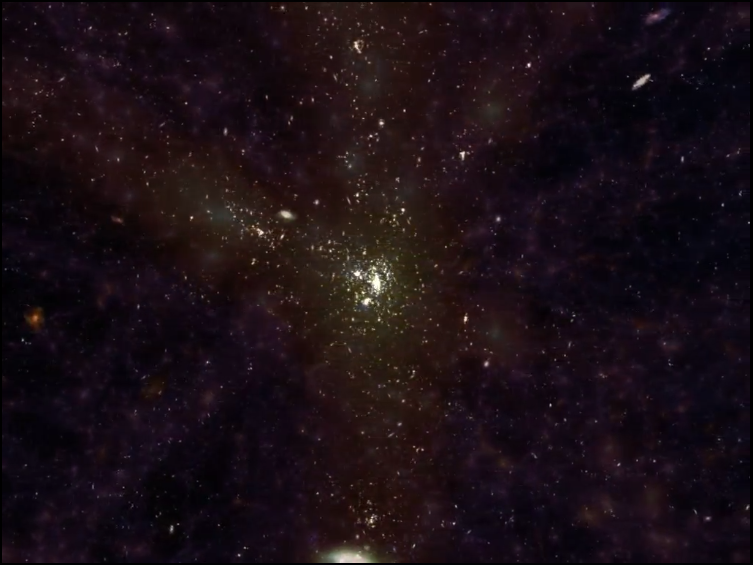
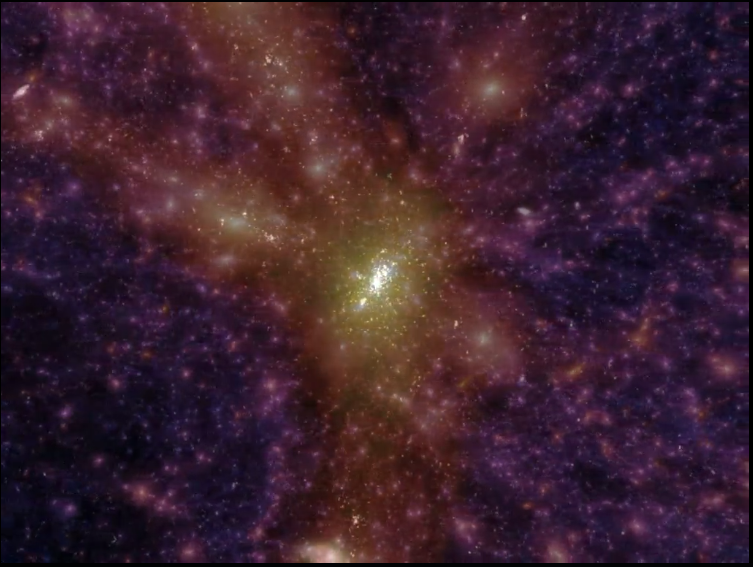
The left hand panel shows the location of galaxies predicted by GALFORM in a region of the Millennium Simulation centred on a massive halo in the dark matter distribution (right)
Recent highlights include:
- An improved treatment of star formation, which follows the molecular and atomic hydrogen content of the ISM (Lagos et al. 2011 )
- A physical model for the transfer of mass and metal in bubbles inflated by SNe in the ISM (Lagos et al. 2013)
- Predictions for the evolution of the galaxy luminosity function in the rest-frame UV from z=3 to z=10 (Lacey et al. 2011 )
- The construction of mock galaxy catalogues on an observer's past lightcone (Merson et al. 2013)
- Predictions for the CO-emission from galaxies by combining GALFORM with a model of photon-dominated regions (Lagos et al. 2012)
- A hybrid model of the formation and growth of black holes and galaxies (Fanidakis et al. 2011 )
- Constraints on the mode of SMBH fuelling from AGN/quasar clustering (Fanidakis et al. 2013a, Fanidakis et al. 2013b )
- Predictions for the stellar halo of Milky Way like galaxies (Cooper et al. 2010 )
- Galaxy formation in a Warm Dark Matter universe (Benson et al. 2013 )