General Relativistic cosmological simulations and observations
Traditional cosmological simulations are "Newtonian", in the sense that the "simulation particles", which should considered as a sample of the underlying matter (or energy) density field, are evolved under the action of Newtonian gravity. Such simulations follow the Newtonian concept of space and therefore do not allow general relativistic studies where spacetime is curved and evolves as the Universe becomes increasingly inhomogeneous.
While its effect on the motions of simulation particles may be small, the spacetime curvature, or general relativistic potentials, can complicate cosmological observations in various ways. For example, photons escaping a gravitational potential well, such as produced by a galaxy cluster, may be redshifted, and on their way to the observer their trajectories are deflected, leading to perturbations to the distances of cosmological objects. Such effects, while generally small, may be singled out from observational data using carefully designed statistics.
There is also ongoing debate about one of the foundations of modern cosmology, namely the assumption that on large scales the spacetime of the Universe is accurately described by the Friedmann-Robertson-Walker metric, so that the Hubble expansion rate can be calculated from the Friedmann equation by assuming an averaged, homogeneous, matter field. However, it has long been questioned whether it is valid to swap the order between spatially averaging the metric and applying Einstein's equations.
Interested in these topics, we have developed a new N-body code, GRAMSES (Barrera-Hinojosa & Li 2019, Barrera-Hinojosa & Li 2020), to do high-resolution cosmological simulations in a general relativistic framework. The code adopts a constant-mean-curvature slicing and minimum distortion gauge, to solve the Einstein equations and calculate the scalar and vector general relativistic potentials in the spacetime curvature. It is an adaptive mesh refinement code, which hierarchically refines the spatial mesh used to solve the potentials to achieve higher resolution in dense regions; this feature allows the potentials to be accurately solved in the highly inhomogeneous regime. The group at ICC is actively involved in the analysis of simulations using this code at the moment.
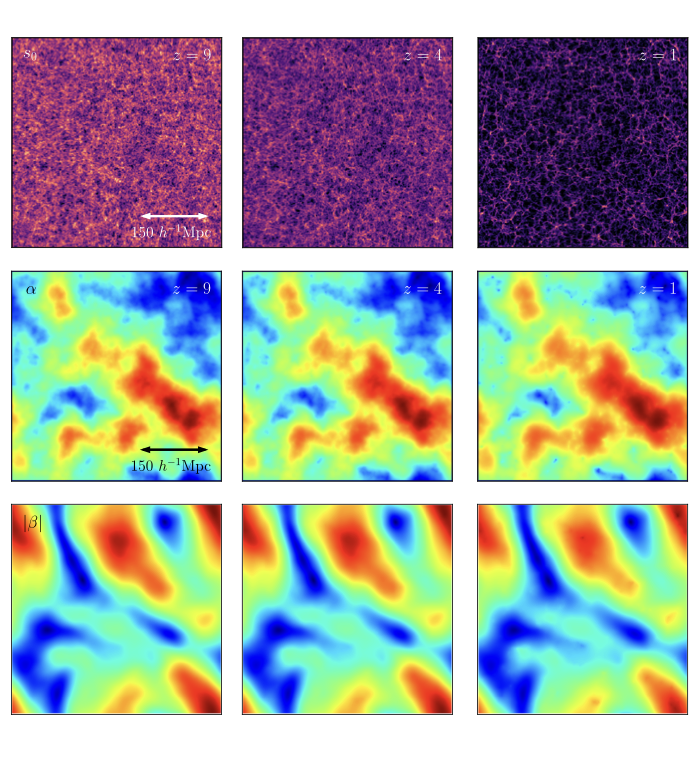 |
| A visualisation of GRAMSES simulations. Upper Panels: the matter density field at z=9 (left), z=4 (middle) and z=1 (right). Central Panels: the corresponding maps of one of the general relativistic potentials, the lapse, for the same three redshifts. Lower Panels: the corresponding maps of the module of the shift vector. |