Dark Energy and Alternative Gravity
The accelerated expansion of our Universe implies that we may currently have incomplete knowledge about the energy content of the Universe or the large-scale behaviour of gravity. In recent years, the latter idea has attracted substantial research interest. If the law of gravity is modified, in addition to the Hubble expansion rate, the inter-particle interactions can also be affected, which change the clustering pattern and amplitudes of the large-scale structures.
Current and future cosmological data have the power of constraining and distinguishing between different classes of gravity theories. However, the most interesting aspects of those theories often lie deep in the nonlinear regime of structure formation, and consequently the ideal places to test them are scales relevant for galaxies and galaxy clusters. Reliable quantitative theoretical predictions on such scales can only be made using numerical simulations, not only because the density field is highly nonlinear, but also because of the intrinsic nonlinearity of the theories themselves (i.e., the screening mechanism).
Thanks to its supercomputing resources and expertise in numerical simulation techniques (such as the modified gravity versions of N-body codes RAMSES, Gadget and Arepo), the ICC has been a leading centre in performing large and high-resolution simulations to study the structure formation in different gravity theories. Some recent research highlights are:
- Realistic simulations of galaxy formation in modified gravity: we have developed an efficient version of modified Arepo (Arnold et al. 2019, Leo et al. 2019), which implements some of the leading modified gravity models such as f(R) gravity and the DGP braneworld model, to study galaxy formation in such models using the state-of-the-art subgrid baryonic physics model from the Illustrious-TNG and the Auriga projects. This allows us to fully resolve the details of Milky-Way-sized galaxies, and quantify how stars form and distribute, how gas cools and gets heated, and how the modified gravitational force behave, in such objects (see Fig. 1).
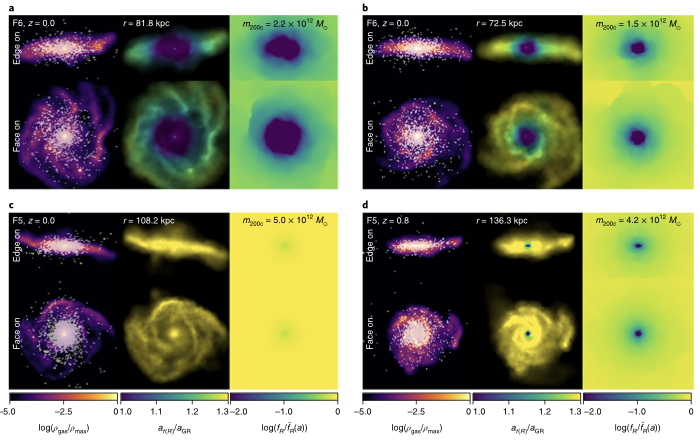
Fig. 1: Four selected galaxies from the SHYBONE galaxy formation simulations in f(R) gravity. In each panel, the left column shows the distribution of stars on top of gas, the central column shows the spatial profile of the fifth force to gravity ratio, and the right column shows the spatial profile of the scalar field. The top and bottom rows in each panel are respectively the galaxy viewed edge on and face on. - Constraining gravity using redshift space distortions: RSD is a powerful cosmological probe of the cosmic velocity field, and can place stringent constraints on modified gravity theories where the growth of large-scale structure is enhanced. Based on a very-high resolution simulation of f(R) gravity (Shi et al. 2015), He et al. (2018), extending earlier study of He et al. (2016), placed a strong constraint on this model using RSD on small scales (see Fig. 2). The group also analysed RSD on large scales and assessed its potential in constraining models (Hernandez-Aguayo et al. 2019).
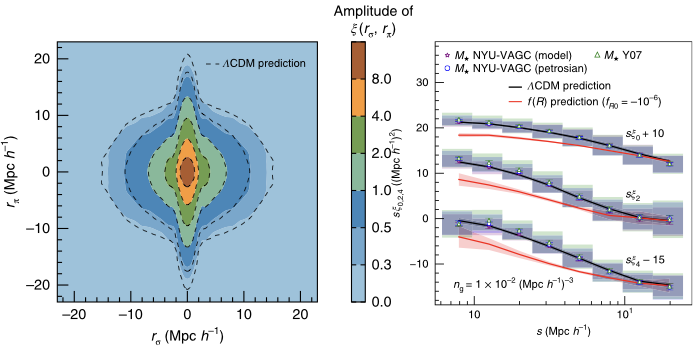
Fig. 2: Left Panel: the 2D redshift space galaxy correlation functions from SDSS observations (coloured contours) and predictions for LCDM (dashed contours). Right Panel: the corresponding multipole moments of redshift space galaxy correlation, respectively shown as symbols with error bars and black solid lines; the red solid lines are the predictions of a f(R) gravity model with f_R0=-1e-6. - Constraining gravity using galaxy clusters: Mitchell et al. (2018, 2019), based on earlier work of He & Li (2016), developed a framework to consistently use the number counts of galaxy clusters to test one of the leading modified gravity theories, f(R) gravity, or chameleon theory. Despite the complicated effect of a chameleon-screened modified gravity on the formation and evolution of structures, it was found that the modified gravity effects on important properties of dark matter haloes, such as their dynamical mass and concentration-mass relation, can be modelled in an exceedingly simple way.
- Constraining gravity using cosmic voids: the leading modified gravity models, such as f(R) gravity and DGP model, employ screening mechanisms to suppress deviation from General Relativity in high-density regions, which makes low-density regions, or cosmic voids, an ideal place to find their signatures and test them, as found by a series of studies (Barreira et al. 2015, 2017; Cautun et al. 2018; Paillas et al. 2019; Davies et al. 2019).
- Screening maps of the local Universe: in screened modified gravity theories, the deviation from General Relativity often depends on the local environment an astronomical object lives in, such as its density, depth of Newtonian potential or spatial derivatives of the potential. Shao et al. 2019 proposed to use constrained-realisation simulations to produce the late-time matter density field of our local Universe, and use these density field to calculate the behaviour of a given modified gravity model, i.e., the screening map of the local Universe.
- Modified gravity effect on the standardisability of type Ia supernovae: Wright & Li 2018 studied the effect of a time-varying Newton constant G on type Ia supernovae (SNe Ia), and found that in this scenario the light curves of SNe Ia can still be standardised, but the luminosity is a function of time. Zhao et al. 2018 utilised this result to propose a new method to constrain the time variation of G by using gravitational wave standard sirens to calibrate the luminosity distances for SNe Ia.
- Improving the theoretical predictions of matter clustering: Cataneo et al. 2019 developed a general method to compute the nonlinear matter power spectrum for dark energy and modified gravity scenarios with percent-level accuracy on scales as small as k = 1h/Mpc. Cataneo et al. 2019 developed an accurate fitting formula for the halo mass function in f(R) gravity.
- Simulation studies of the Galileon gravity model: Galileon gravity is an important subclass of modified gravity models that employ the Vainshtein screening mechanism to evade local constraints of gravity. These models involve higher-order derivative couplings of a scalar field, and we have developed numerical tools to simulate their impact on cosmological observations (Barreira et al. 2012; Barreira et al. 2013a, 2013b, 2013c; Li et al. 2013; Barreira et al. 2014a, 2014b).